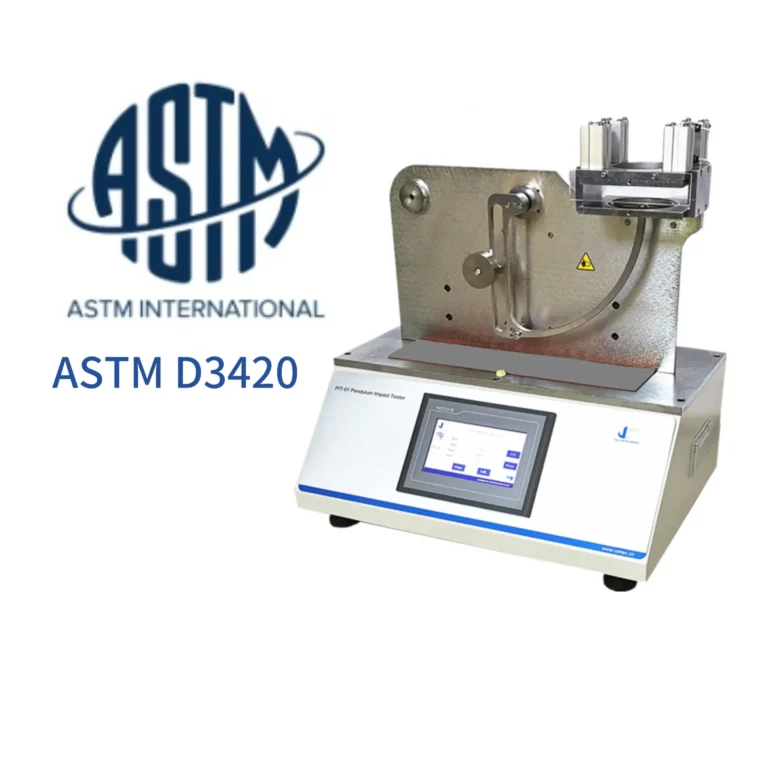
ASTM D3420
Test d'impatto con pendolo su film
For packaging, medical, and industrial films, impact resistance is a critical property that determines a material’s ability to withstand sudden mechanical stress during production, shipping, and use. The ASTM D3420 standard provides a reliable and repeatable method to evaluate this property through a film pendulum impact test, often referred to as the Prova d'urto Spencer.
This guide introduces the principles behind ASTM D3420, explains key test procedures, and demonstrates how modern pendulum impact testing equipment—like the PIT-01 Tester d'impatto a pendolo from Cell Instruments—ensures accurate measurement of the resistenza all'impatto del pendolo di film plastici.
Understanding ASTM Standards for Impact Testing of Plastics
ASTM D3420 measures the energy required to rupture a film by a pendulum-style impact, simulating dynamic tensile loading. Unlike slow-speed tensile tests, this high-speed impact test better reflects real-world strain rates experienced in flexible packaging and plastic film applications.
There are two main test procedures:
-
Procedure A: Uses a 60 mm aperture and larger impact head (25.4 mm diameter)
-
Procedure B (Spencer Impact Test): Uses an 89 mm aperture and smaller impact head (19.0 mm diameter)
Each procedure calculates the energia d'impatto based on the pendulum’s swing displacement, offering insight into material durability and fracture behavior. The data from these methods are not interchangeable, so selecting the appropriate one depends on the film type and application.
Key Applications of Film Pendulum Impact Testing
Il resistenza all'impatto del pendolo di film plastici is a vital specification in multiple industries:
-
Imballaggio flessibile: Evaluates puncture resistance in food pouches, sachets, and medical packaging.
-
Automotive and Aerospace: Measures shock durability of interior films and composite layers.
-
Costruzione: Tests laminates, membranes, and vapor barriers for mechanical resilience.
-
Carta e stampa: Assesses coated paper and multilayer substrates for tear and rupture resistance.
For all these applications, film impact resistance testing ensures that materials can endure real-world handling, sealing, and mechanical stresses without failure.
Conducting a Film Pendulum Impact Test
Il prova d'urto con pendolo method involves several standardized steps:
-
Preparazione del campione: Cut at least five test specimens with dimensions suitable for the clamps (e.g., 100 mm diameter or square). Ensure film is flat, uniform, and free of surface defects.
-
Condizionamento: Condition samples at 23 ± 2°C and 50 ± 10% RH per ASTM guidelines to stabilize mechanical properties before testing.
-
Testing Setup:
-
Place the specimen into a clamping unit with a circular aperture (Procedure A: 60 mm, Procedure B: 89 mm).
-
Raise and latch the pendulum to the preset height.
-
Align the impact head with the film center.
-
-
Esecuzione del test:
-
Release the pendulum. It swings downward, striking and rupturing the film.
-
Measure the loss in kinetic energy using a dial or digital readout.
-
-
Result Recording:
-
Calculate impact resistance in joules (J) or cm·kgf using ASTM D3420 equations.
-
Record the average energy of rupture for all specimens.
-
This test provides a quantitative indicator of how much energy a material can absorb before failure—essential for safety and quality control.
Benefits of Using the PIT-01 Pendulum Impact Tester
For laboratories and production QA teams, accuracy, repeatability, and compliance with ASTM standards are non-negotiable. The PIT-01 Tester d'impatto a pendolo by Cell Instruments is designed to meet the stringent requirements of ASTM D3420 e NF T54-116 for prova d'urto con pendolo a pellicola.
Le caratteristiche principali includono:
-
High-precision pendulum with auto-release mechanism
-
Industrial-grade PLC control e 7” touchscreen HMI
-
Multiple energy levels and impact heads to cover a broad testing range
-
Pneumatic clamping system for consistent and slip-free sample mounting
-
Real-time data capture and digital reporting
These features reduce operator error, minimize test variability, and improve the efficiency of pendulum impact resistance tests across research, production, and quality assurance settings.
Spencer Impact Testing Equipment vs. Other Methods
Spencer impact testing equipment (Procedure B) is widely recognized for its versatility in testing thin plastic films. Compared to dart drop methods (e.g., ASTM D1709), pendulum methods provide more consistent results for smooth, homogeneous materials.
Advantages include:
-
Controlled and measurable energy delivery
-
Suitability for a wide range of film types
-
Easy calibration and high reproducibility
-
Compliance with multiple global testing standards
In high-stakes applications, such as pharmaceutical packaging or sterile medical films, using a standardized pendulum impact resistance test ensures confidence in packaging integrity.
Conclusione
ASTM D3420 provides the foundation for accurate and reliable pendulum impact testing of plastic films. By simulating real-life impact events, it helps manufacturers assess the durability and performance of packaging materials under dynamic stress.
Utilizzando il PIT-01 Tester d'impatto a pendolo from Cell Instruments ensures your testing process is not only ASTM-compliant but also efficient and precise. From food packaging to automotive membranes, this test method and equipment are indispensable for delivering safe, high-quality products.
 IT
IT  EN
EN  AR
AR  BG
BG  CS
CS  DA
DA  DE
DE  EL
EL  ES
ES  ET
ET  FI
FI  FR
FR  HU
HU  ID
ID  JA
JA  KO
KO  LT
LT  LV
LV  NB
NB  NL
NL  PL
PL  PT
PT  RO
RO  RU
RU  SK
SK  SL
SL  SV
SV  TR
TR  UK
UK