
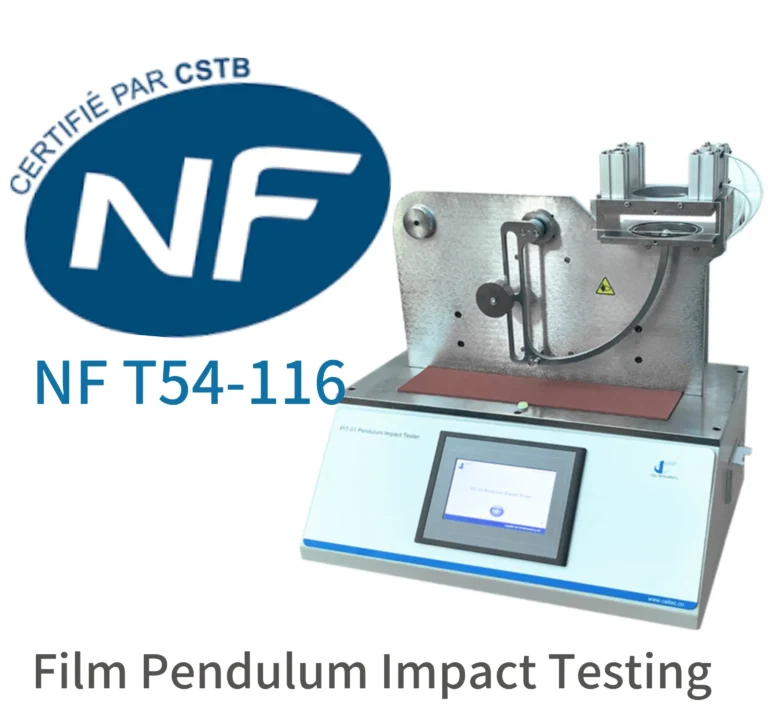
NF T54-116
Film Pendulum Impact Testing
NF T54-116, a French national standard, outlines a reliable test method to evaluate the impact resistance of plastic film through film pendulum impact testing. The procedure measures the energy absorbed during the perforation of a film sample by a hemispherical impactor mounted on a pendulum—also referred to as the pendulum shock test or perforameter method.
In this guide, we’ll break down the key procedures of NF T54-116, its relevance to pendulum impact resistance of plastic film, and how modern equipment such as the PIT-01 Film Pendulum Impact Tester from Cell Instruments ensures precise and reproducible results in compliance with the standard.
Film Pendulum Impact Tester and Spencer Impact Test Explained
The 필름 진자 충격 시험기 specified in NF T54-116 features a pendulum with a 38.1 mm hemispherical head, capable of being loaded with various counterweights to deliver maximum energies ranging from 5 J to 60 J. The test measures the residual energy after the pendulum strikes and perforates the specimen. By calculating the energy loss, the absorbed energy—representing the film’s resistance to puncture—is determined.
This method differs from the Spencer impact test (ASTM D3420 Procedure B), but both share the objective of evaluating film impact resistance at high strain rates. These standards are crucial for ensuring that plastic films used in medical, food, construction, or automotive applications can resist rupture during real-world use.
How NF T54-116 Pendulum Impact Testing Works
The pendulum impact resistance test under NF T54-116 involves the following steps:
-
Specimen Preparation:
Ten specimens measuring 20 cm × 20 cm are cut from various areas of the plastic film roll. Thickness is measured using a micrometer with a resolution appropriate to the film’s gauge. -
Conditioning:
Test samples are conditioned at 23 ± 2 °C for at least two hours to stabilize moisture and mechanical behavior. -
Apparatus Setup:
-
Adjust the pendulum to the zero position by performing a swing test without the specimen.
-
Choose an impact energy that ensures the sample absorbs between 10% and 80% of the total pendulum energy.
-
-
Test Execution:
-
Secure the sample with a pneumatic clamping system to avoid slippage.
-
Align the impactor over the test center and release the pendulum.
-
The absorbed energy is indicated via a scale or digital readout system.
-
Repeat the test across all specimens.
-
-
Calculation and Expression of Results:
-
For each test, calculate perforation resistance using the formula:
W/e, where
W = energy absorbed (Joules)
e = film thickness at impact center (micrometers) -
Record the average energy, standard deviation, and qualitative failure mode (brittle or ductile).
-
Use Cases and Industry Relevance of Film Impact Resistance Testing
The pendulum impact resistance test is widely adopted in industries where plastic films are exposed to mechanical stress:
-
유연한 패키징: Evaluate barrier durability in food and pharmaceutical films.
-
건설: Measure puncture tolerance of membranes and composite wraps.
-
Automotive & Aerospace: Validate the robustness of interior laminates and lightweight composites.
-
Paper and Printing: Test coated and layered substrates used in high-speed operations.
Testing in accordance with NF T54-116 ensures that materials meet stringent specifications for safety, usability, and compliance—especially when integrated with ASTM standards for impact testing of plastics such as ASTM D3420 or D1709.
Advantages of Using the PIT-01 Pendulum Impact Tester
To comply with NF T54-116 and related standards, laboratories and R&D teams require a precise, versatile, and user-friendly film pendulum impact tester. The PIT-01 by Cell Instruments is designed specifically to meet these demands.
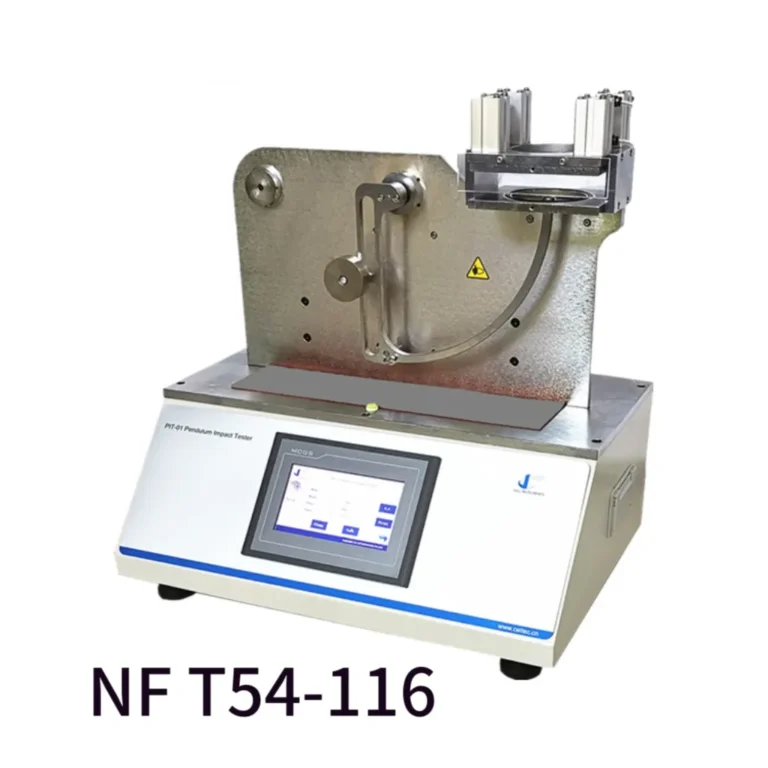
Key Features Include:
-
PLC + 7” HMI Touchscreen for intuitive control and real-time result display
-
Pneumatic clamping ensures uniform and repeatable fixturing
-
Auto-release pendulum mechanism maintains consistent test conditions
-
Configurable energy levels from 1 J to 5 J (optionally up to 60 J)
-
High-resolution energy sensors with 0.001 J accuracy
-
Built-in microprinter and RS-232 interface for result export and report integration
Whether you’re performing a pendulum impact resistance test for R&D, quality control, or compliance auditing, the PIT-01 simplifies the process while enhancing data reliability.
Comparing NF T54-116 with Other Plastic Film Impact Tests
While NF T54-116 is specifically tailored to perforation resistance using a pendulum method, it’s often used alongside other standards:
-
ASTM D3420: Measures energy to puncture plastic film using a pendulum (Spencer Impact).
-
ASTM D1709: Uses a free-falling dart to assess impact failure.
-
ISO 7765-1: A global alternative for dart impact resistance.
Each test method provides a unique view of film toughness, and together, they form a comprehensive profile of material performance under different loading conditions.
Conclusion
NF T54-116 offers a rigorous and reliable framework for evaluating the impact resistance of plastic film using a pendulum impact test. By simulating real-world puncture events, this method helps manufacturers ensure material safety, performance, and compliance across a range of demanding industries.
Equipped with the PIT-01 Pendulum Impact Tester from Cell Instruments, testing teams can execute NF T54-116 and related standards with unmatched precision and efficiency. From packaging to aerospace, accurate film impact resistance data is key to product quality and innovation.
 KO
KO  EN
EN  AR
AR  BG
BG  CS
CS  DA
DA  DE
DE  EL
EL  ES
ES  ET
ET  FI
FI  FR
FR  HU
HU  ID
ID  IT
IT  JA
JA  LT
LT  LV
LV  NB
NB  NL
NL  PL
PL  PT
PT  RO
RO  RU
RU  SK
SK  SL
SL  SV
SV  TR
TR  UK
UK